| The Code Book - The Evolution of Secrecy from Mary, Queen of Scots to Quantum Cryptography (1999) |
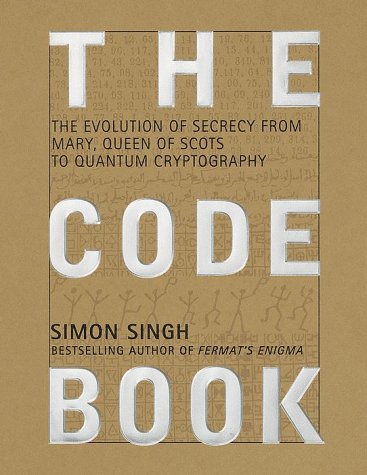
| Front Cover | Book Details | |||||||||||||
|
|
| Plot |
| Amazon.com People love secrets, and ever since the first word was written, humans have written coded messages to each other. In The Code Book, Simon Singh, author of the bestselling Fermat's Enigma, offers a peek into the world of cryptography and codes, from ancient texts through computer encryption. Singh's compelling history is woven through with stories of how codes and ciphers have played a vital role in warfare, politics, and royal intrigue. The major theme of The Code Book is what Singh calls "the ongoing evolutionary battle between codemakers and codebreakers," never more clear than in the chapters devoted to World War II. Cryptography came of age during that conflict, as secret communications became critical to either side's success. Confronted with the prospect of defeat, the Allied cryptanalysts had worked night and day to penetrate German ciphers. It would appear that fear was the main driving force, and that adversity is one of the foundations of successful codebreaking. In the information age, the fear that drives cryptographic improvements is both capitalistic and libertarian--corporations need encryption to ensure that their secrets don't fall into the hands of competitors and regulators, and ordinary people need encryption to keep their everyday communications private in a free society. Similarly, the battles for greater decryption power come from said competitors and governments wary of insurrection. The Code Book is an excellent primer for those wishing to understand how the human need for privacy has manifested itself through cryptography. Singh's accessible style and clear explanations of complex algorithms cut through the arcane mathematical details without oversimplifying. Can't get enough crypto? Try solving the Cipher Challenge in the back of the book--$15,000 goes to the first person to crack the code! --Therese Littleton From The Industry Standard During the late 19th century, private citizens and businesses began to rely less on the dependable but slow postal system, and more on a new method of transmitting and receiving messages, news and financial data. The breakthrough technology was the telegraph, and almost as soon as people started using it, they began to think of ways to safeguard private communications from prying eyes. One writer in England's Quarterly Review described the problem in 1853: "The clerks of the English Telegraph Company are sworn to secrecy, but we often write things that would be intolerable to see strangers read before our eyes. This is a grievous fault in the telegraph, and it must be remedied by some means or other." A simple solution to snooping telegraph operators was to encrypt messages before handing them over to transmit, a practice that became common for individuals and companies alike. A hundred years later, we are in the midst of another telecommunications transformation, and concern over privacy is more intense than ever. As our private e-mail messages and credit card numbers ricochet around the world at dizzying speed, encryption remains the cornerstone of our security. Of course, as author Simon Singh explains in The Code Book, our methods of encryption have evolved along with our communications technologies. In a sweeping overview, Singh traces the evolution of secret writing from the time of Herodotus to the present day. Along the way, he tells tales of the treasonous, though simply coded communications of Mary, Queen of Scots; Louis XIV's Great Cipher, which went unsolved for two centuries; and Charles Babbage's 1850s deciphering of the supposedly uncrackable polyalphabetic Vigenere Cipher. He also details the World War II-era work of Navajo code-talkers and the cracking of the German Enigma machine, as well as the United States' and England's nearly simultaneous discovery of public-key cryptography in the 1970s. Author of the 1997 bestseller Fermat's Enigma, Singh casts the relationship between codemaking and codebreaking in evolutionary terms: Like strains of infectious bacteria, ciphers grow stronger because, as the weak are deciphered, necessity demands that more difficult-to-crack codes take their place. Although Singh fashions a compelling history, as well as a skillful explanation of the analytical underpinnings of cryptographs, the most dramatic moments in the book come in the last three chapters. As the book draws to a close, the author walks readers through such events of the past 20 years as the invention of public-key cryptography and recent experiments to employ quantum mechanics in the quest for the unbreakable code. The public-key method - the first cryptographic system in history that doesn't require both parties in a transaction to share a secret key - is considered the most important advance in codemaking within the past 2,000 years. Public-key encryption makes possible familiar computer transactions like secure e-mail and e-commerce, without which using a credit card on the Web would be no more secure than leaving a wallet on the bus. Public-key cryptography also helped revive a debate over encryption that pits citizen privacy against government security. As Singh commented at a recent book reading in San Francisco, "I could send you a message encrypted through free software on the Net, and the combined forces of the GCHQ, the NSA, the CIA and the FBI wouldn't be able to crack that code. And if they did manage to," he added, "I could just re-encrypt with Version 2.0." Singh understands an essential truth about secrets: You can crack a code if you ask the right questions, but sometimes the answers evolve themselves out of existence. -- Maria De La O The New York Times Book Review, Robert Osserman His exposition is especially effective at putting the reader in the code breaker's shoes... From Scientific American The ancient battle between people who want to preserve secrets and people who want to discover them proceeds as a form of evolution. Codemakers devise a better means of encryption; codebreakers solve it, forcing the encoders to find another improvement. Singh, trained in physics but now an author of works on science, spins an absorbing tale of codemaking and codebreaking over the centuries. Does the simple monoalphabetic substitution cipher, which replaces each letter of a message with a letter from a cipher alphabet, no longer suffice? Replace it with a code using two or more cipher alphabets. When that no longer outwits the cryptanalysts, encode with a Vigenère square, in which a plaintext alphabet is followed by 26 cipher alphabets. And so on through one-time pad ciphers, cryptographic machines and public-key cryptography. Singh explains them all deftly. Looking to the future, he sees "one idea in particular that might enable cryptanalysts to break all today's ciphers." It is the quantum computer. If it can be built, "it would be able to perform calculations with such enormous speed that it would make a modern supercomputer look like a broken abacus." Or perhaps the cryptographers will triumph with quantum cryptography. "If quantum cryptography systems can be engineered to operate over long distances, the evolution of ciphers will stop. The quest for privacy will have come to an end." The New York Times, Richard Bernstein It would be harder to imagine a clearer or more fascinating presentation of cryptology and decryptology than nonspecialists will get in this book. From Booklist For millennia, secret writing was the domain of spies, diplomats, and generals; with the advent of the Internet, it has become the concern of the public and businesses. One cyber-libertarian responded with the freeware encryption program Pretty Good Privacy (PGP), and Singh similarly meets a sharpening public curiosity about how codes work. His first popular foray into a mathematical topic, Fermat's Last Theorem (1997), nicely balanced technical detail with vibrant storytelling, a quality happily present again here. Although the quantum-mechanical encryption with which Singh culminates his narrative is challengingly arcane to most except for the math spooks at the National Security Agency, Singh successfully conveys its essential principles, as he does those of all major ciphering schemes. Beginning with such simple ideas as monoalphabetic substitution, which can protect the communications of a boy's treehouse club but not much more, Singh underscores with stories how codemakers and codebreakers have battled each other throughout history. A tool called frequency analysis easily defeats the monoalphabetic cipher, and encryptors over time have added the Vigenere square, cipher disks, one-time pads, and public-key cryptography that underlies PGP. But each security strategy, Singh explains, contains some vulnerability that the clever code cracker can exploit, an opaque process the author splendidly illuminates. Instances of successful decipherment, as of Egyptian hieroglyphics or the German Enigma cipher system in World War II, combine with Singh's sketches of the mathematicians who have advanced the art of secrecy, from Julius Caesar to Alan Turing to contemporary mathematicians, resulting in a wonderfully understandable survey. Gilbert Taylor Book Description Codes have decided the fates of empires, countries, and monarchies throughout recorded history. Mary, Queen of Scots was put to death by her cousin, Queen Elizabeth, for the high crime of treason after spymaster Sir Francis Walsingham cracked the secret code she used to communicate with her conspirators. And thus the course of British history was altered by a few sheets of cryptic prose. This is just one link in humankind's evolutionary chain of secret communication, and just one of the fascinating incidents recounted in The Code Book, written by bestselling author Simon Singh. Combining a superb storyteller's sense of drama and a scientist's appreciation for technical perfection, Singh traces the evolution of secret writing from ancient Greek military espionage to the frontiers of computer science. The result is an epic tale of human ingenuity, with examples that range from the poignant to the peculiar to the world-historical. There is the case of the Beale ciphers, which involves Wild West escapades, a cowboy who amassed a vast fortune, a buried treasure worth $20 million, and a mysterious set of encrypted papers describing its whereabouts--papers that have baffled generations of cryptanalysts and captivated hundreds of treasure hunters. A speedier end to a bloody war was the only reward that could be promised to the Allied code breakers of World Wars I and II, whose selfless contributions altered the course of history; but few of them lived to receive any credit for their top-secret accomplishments. Among the most moving of these stories is that of the World War II British code breaker Alan Turing, who gave up a brilliant career in mathematics to devote himself to the Allied cause, only to end his years punished by the state for his homosexuality, while his heroism was ignored. No less heroic were the Navajo code talkers, who volunteered without hesitation to risk their lives for the Allied forces in the Japanese theater, where they were routinely mistaken for the enemy. Interspersed with these gripping stories are clear mathematical, linguistic, and technological demonstrations of codes, as well as illustrations of the remarkable personalities--many courageous, some villainous, and all obsessive--who wrote and broke them. All roads lead to the present day, in which the possibility of a truly unbreakable code looms large. Singh explores this possibility, and the ramifications of our increasing need for privacy, even as it begins to chafe against the stated mission of the powerful and deeply secretive National Security Agency. Entertaining, compelling, and remarkably far-reaching, this is a book that will forever alter your view of history, what drives it, and how private that e-mail you just sent really is. Included in the book is a worldwide Cipher Challenge--a $15,000 award will be given by the author to the first reader who cracks the code successfully. Progress toward the solution will be tracked on The Code Book website. Book Info Offers a peek into the world of cryptography and codes, from ancient texts through computer encryption. Singh calls the ongoing evolutionary battle between codemakers and codebreakers,never more clear than in the chapters devoted to World War II. DLC: Cryptography-History. From the Back Cover Praise for Fermat's Enigma by Simon Singh: "Vividly recounted...I strongly recommend this book to anyone wishing to catch a glimpse of what is one of the most important and ill-understood, but oldest, cultural activities of humanity...an excellent and very worthwhile account of one of the most dramatic and moving events of the century." --Roger Penrose, The New York Times Book Review "How great a riddle was Fermat's 'last theorem'? The exploration of space, the splitting of the atom, the discovery of DNA--unthinkable in Fermat's time--all were achieved while his Pythagorean proof still remained elusive...Though [Singh] may not ask us to bring too much algebra to the table, he does expect us to appreciate a good detective story." --The Boston Sunday Globe "It is hard to imagine a more informative or gripping account of...this centuries-long drama of ingenious failures, crushed hopes, fatal duels, and suicides." --The Wall Street Journal "[Singh] writes with graceful knowledgeability of the esoteric and esthetic appeal of mathematics through the ages, and especially of the mystifying behavior of numbers." --The New York Times "[Singh] has done an admirable job with an extremely difficult subject. He has also done mathematics a great service by conveying the passion and drama that have carried Fermat's Last Theorem aloft as the most celebrated mathematics problem of the last four centuries." --American Mathematical Society "The amazing achievement of Singh's book is that it actually makes the logic of the modern proof understandable to the nonspecialist...More important, Singh shows why it is significant that this problem should have been solved." --The Christian Science Monitor About the Author Simon Singh received his Ph.D. in physics from the University of Cambridge. A former BBC producer, he directed an award-winning documentary film on Fermat's Last Theorem that aired on PBS's "Nova" series, and wrote the bestselling book Fermat's Enigma. He lives in London, England. |
|
|
||||||||||||||||||||||||||||||||||||||||||||||||
| Notes |
| Includes bibliographical references (p. 388-393) and index. Companion Website: http://www.simonsingh.net/ |